
Best Dehumidifier for Mold Prevention: Sizing, Placement, and Settings
If you’re serious about stopping mold before it starts, the right dehumidifier can make the difference between dry walls and a musty basement. But most guides oversimplify: they tell you to buy a “40-pint for a basement” and call it done. That’s often wrong. The real driver is continuous moisture removal at the right temperature — not just raw pint capacity. The counter-intuitive angle most articles skip: oversizing a dehumidifier can actually promote mold growth by short-cycling before air circulation finishes drying surfaces. Here’s the sizing, placement, and settings framework that actually works.
For [mold prevention](https://thecleantips.com/remove-black-mold-from-tile-grout/), choose a dehumidifier rated for at least 50–70 pints per day (AHAM-rated) for a typical damp basement or large room (500–1,500 sq ft). But capacity alone isn’t enough — you need a unit with a built-in humidistat that can hold a setpoint below 55% relative humidity (RH) , a continuous drain option, and an auto-restart feature. Place it 6–12 inches from walls with clear airflow on all sides, and set the target humidity to 45–50% RH rather than running it at max continuously. That’s the buy-it-once prescription for mold prevention.
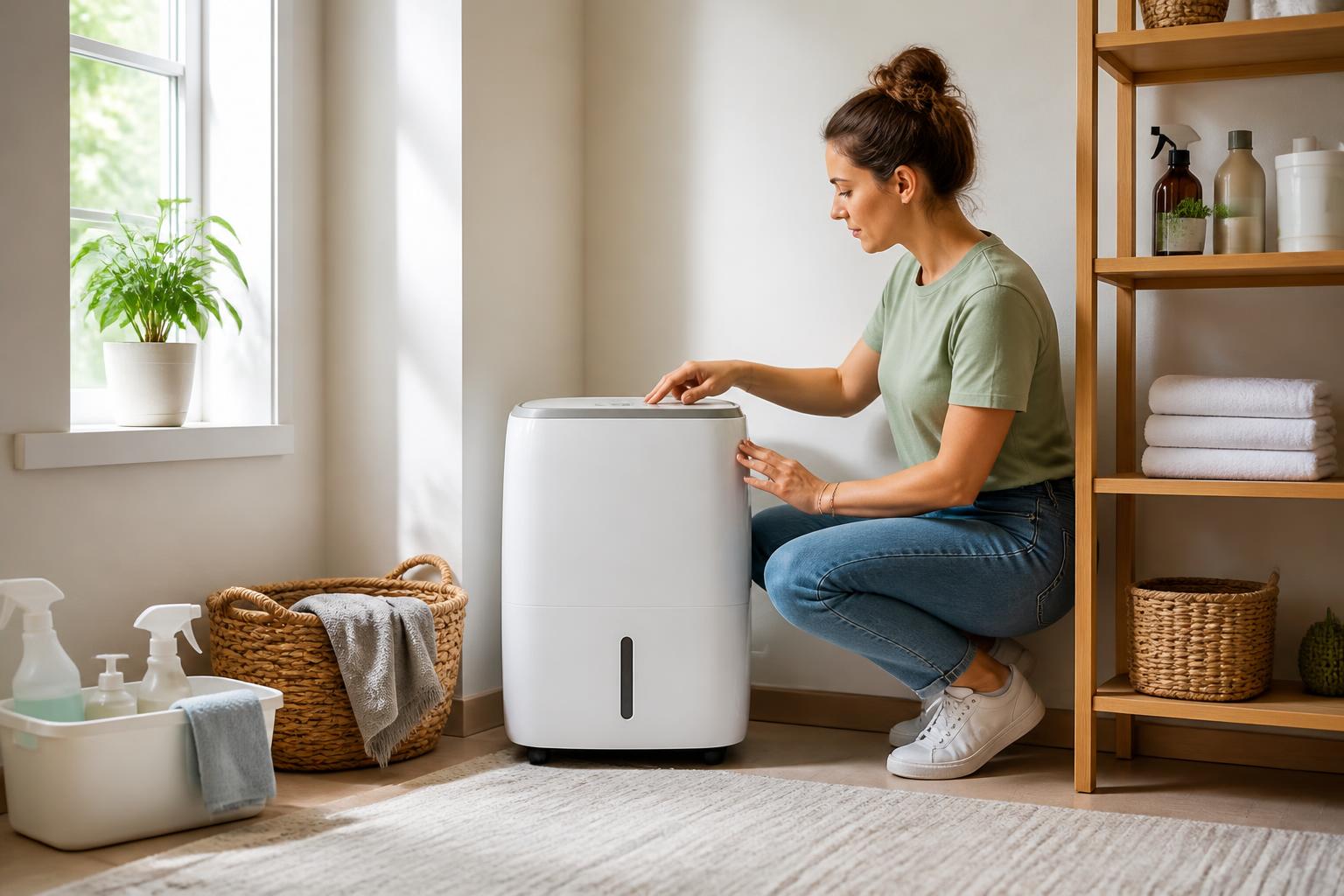
Quick answer
For mold prevention, you need a dehumidifier that can maintain 45–50% RH in your specific space without manual emptying or power-loss interruptions. The minimum spec is a 50-pint/day AHAM-rated unit with a continuous drain port and auto-restart that remembers your settings after a blackout. If your space runs cooler than 65°F — typical for basements and crawl spaces — verify the unit’s low-temperature performance rating. Many household units lose half their efficiency below 60°F, which means they’ll run constantly but never hit your target RH.
How to verify fit on your actual unit: After setup, place a separate hygrometer (not the unit’s built-in sensor) at the opposite end of the room, 5 feet off the floor. Let the dehumidifier run for 24 hours. If the external hygrometer reads above 55% RH while the unit’s display says 50%, your unit’s sensor is drifting or the airflow is blocked. If the unit cycles on and off every 10–15 minutes during humid conditions, it’s oversized for the space and will leave surface moisture on walls and flooring.
Comparison framework
The table below cuts through marketing specs to the specs that actually matter for mold prevention. All figures are based on typical residential conditions (around 70°F, 60% starting RH). Always verify against your unit’s manual and your own space.
| Feature | Why It Matters for Mold | Minimum Threshold | What to Avoid |
|---|---|---|---|
| Pint capacity (AHAM-rated) | Determines how fast it pulls water; underpowered units let humidity spike overnight | 50 pint/day for 1,000 sq ft basement | “Compact” 20–30 pint units in a damp area |
| Low-temperature performance | Basements and crawl spaces run 55–65°F; many units lose 50%+ efficiency below 65°F | Rated to work at 50°F or lower | Units that say “optimal above 70°F” |
| Humidistat accuracy | Prevents over-humidifying or useless short cycles | Adjustable setpoint ±3% RH | No setpoint dial — just “on/off” or “auto” |
| Continuous drain | Emptying a 1.5-gallon bucket twice a day is untenable for prevention | ⅜” hose compatible | Units that only collect into a bucket with no drain option |
| Auto-restart after power loss | Prevents humidity rebound during storms or outages | Yes, memory auto-restart | No auto-restart — must be manually reset |
Fast fit/no-fit decision aid
Before you buy, run through these five checks. Pass all? The unit is a strong candidate. Fail any? Keep looking.
- [ ] The AHAM-rated pint capacity is at least 50 for 1,000 sq ft of damp space (or 70 for 2,000+ sq ft).
- [ ] The unit is rated to operate at 50°F or lower for your basement or crawl space.
- [ ] The humidistat allows you to set a specific RH below 55% (not just “auto” or a vague dial).
- [ ] A continuous drain connection is possible without lifting the bucket (hose included or available).
- [ ] The unit has auto-restart that remembers your settings after a power outage.
Best-fit picks by use case
Basement or crawl space (most common mold zone)
Look for units with pump-assisted continuous drainage (so water can be pushed up to a drain) and low-temperature compressor protection. A 70-pint unit with a built-in pump is the sweet spot. Without a pump, you’re stuck draining downhill or lugging a bucket.
Expert tip #1: Don’t rely on the “auto” mode that runs until a certain humidity is reached — it often stops at 60% RH, which is too high for mold prevention. Manually set it to 50% RH. Common mistake: setting it to 40% RH, which overworks the unit and risks freezing the coils in a cold basement.
Large open room (family room, basement rec area)
A 50–55 pint unit with a fan-speed setting is sufficient if the space is well-insulated and not actively wet. Place it centrally. Avoid units that blast high-speed air at your sofa — look for one that lets you choose “low fan” for quieter operation while still pulling moisture.
Expert tip #2: Position the dehumidifier so its exhaust (warm, dry air) is directed toward the center of the room, not against a cold wall. Common mistake: placing it directly in front of a concrete wall — that wall will stay cold and produce condensation regardless of what the unit does.
Small damp room (laundry room, bathroom without fan)
A 30–35 pint unit can work here, but only if it has a continuous drain. The bucket will fill in 6–8 hours. Critical: This unit should be small enough to sit on a shelf or counter, not on the floor where it might get splashed. Floor placement in a laundry room invites dust and lint clogging.
Expert tip #3: Clean the pre-filter every two weeks in a small room with lint or dust — more often if you use fabric softener sheets. Common mistake: assuming the filter is good for the whole season; a clogged filter cuts airflow by 30–40% and ruins the unit’s ability to meet its rated pint capacity.
Trade-offs to know
Bigger isn’t better. An oversized unit (e.g., 70 pint in a 300 sq ft room) will pull humidity down to 30% quickly, then short-cycle — meaning it shuts off before the air has circulated enough to dry surface mold. Mold spores need surface moisture, not just airborne humidity. A correctly sized unit runs longer per cycle, which dries walls and floors too.
Pump vs. gravity drain. Units with pumps cost $50–100 more but can lift water 5–10 feet vertically. Without a pump, you need a floor drain or a sump pit lower than the dehumidifier. If your basement has no floor drain, a pump unit is non-negotiable for hassle-free operation.
Energy use trade-off. A 70-pint unit running 10–12 hours a day draws about 700–800 watts — that’s roughly $0.10–0.15/hour (check your local rate). Over a month, expect an extra $30–45 on your electric bill. A 50-pint unit may save you $10–15/month but may not keep up if your space is borderline. Run the numbers: a few extra dollars is cheaper than mold remediation.
Filters need monthly cleaning. Nearly every unit has a washable pre-filter. If you ignore it for three months, airflow drops significantly and the unit can’t hit its rated pint capacity. Set a calendar reminder.
Related questions
How low should I set the humidity for mold prevention?
45–50% RH is the sweet spot. Below 40% wastes energy and can dry out wood floors and skin. Above 55% still allows mold to grow on cool surfaces. Use a separate hygrometer to verify — the dehumidifier’s built-in sensor can be off by ±5%.
Can I run a dehumidifier 24/7?
Yes, as long as it has a continuous drain and auto-restart. Units with a bucket stop collecting once the bucket is full, and that humidity spike can happen in a few hours. Running it nonstop is fine — most modern units cycle on and off automatically.
Should I put the dehumidifier in the middle of the room or against a wall?
Place it 6–12 inches away from walls for proper airflow. Against a wall, the intake gets starved and the unit runs less efficiently. Center of the room is ideal, but near a drain outlet might be more practical — just ensure the intake side is clear.
Explore This Topic
– Mold-Resistant Paint, Primer, and Sealants: Do They Really Work?
– How to Remove Black Mold from Tile Grout: Deep Clean and Prevention
– How to Remove Mold from Carpet and Carpet Padding

Sir Cleans a Lot is a professional home cleaning specialist with over 10 years of hands-on experience. He has helped thousands of homeowners tackle stubborn stains, eliminate mold, and keep their homes spotless using practical, science-backed methods. When he’s not testing the latest cleaning products or researching stain removal techniques, he’s sharing his expertise to make cleaning easier for everyone.